Agumbe · Ayvro guide
Agumbe in the rain: slow roads, deep forest
We would not plan Agumbe around a waterfall list. The road, the forest and the weather decide what the trip will actually be.
Quick guide
The basics
- Distance
- Roughly 350 km from Bengaluru
- Time to allow
- At least two days with one overnight stay
- Landscape
- Western Ghats rainforest, village and ghat roads
- Monsoon season
- June to September is the wettest, most atmospheric period
- Stay options
- Limited in Agumbe; more choices around Thirthahalli
- Recheck
- Road status, forest access, waterfall access and local guide requirements
In this guide 4 min read
Start here
The road is half the story
Agumbe sits roughly 350 kilometres from Bengaluru, beyond a long run into the Western Ghats and a final ghat road that rain can reduce to a patient crawl. We would keep that last stretch in daylight; leave late and the first day disappears behind a windscreen.
We would not make the waterfalls the anchors of a monsoon plan. Forest access changes, approaches become unsafe and cloud can swallow the view. We would come for the village and rainforest, then treat any waterfall that is genuinely open as a bonus.
Share this sectionThe forest is the destination
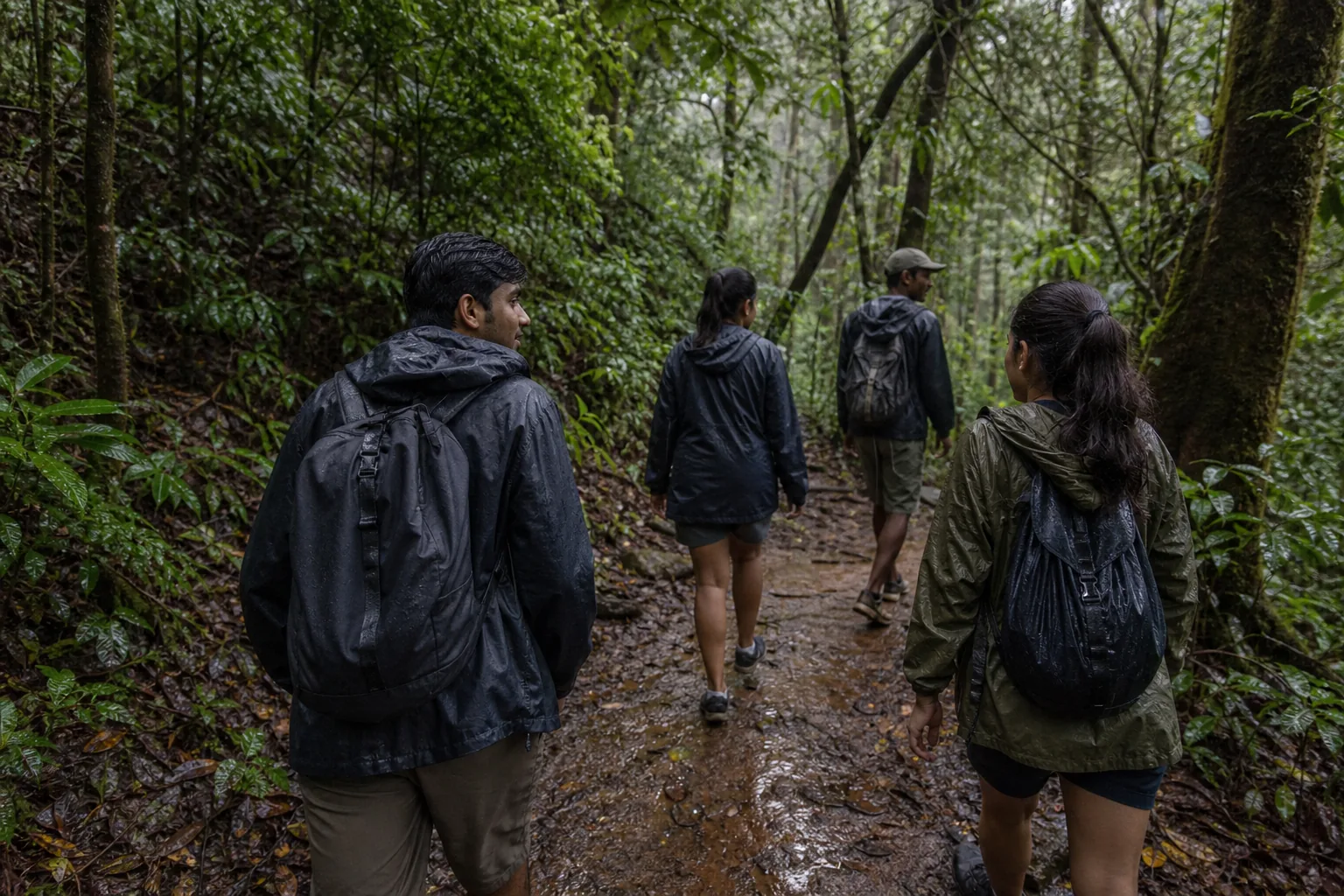
When we plan Agumbe, we treat the village and rainforest as the destination. This is a small settlement inside one of the wettest stretches of the Western Ghats, where forest presses close to the road, mist moves quickly and rooms are scarce. The waterfalls are excursions; they are not the whole place.
Onake Abbi, Barkana and Jogi Gundi dominate search results, which makes them look like three reliable stops on a circuit. We would never promise that circuit before checking locally. A week of hard rain can alter the road, the trail and the permission to enter.
Our fallback for a closed trail is not another unmarked trail. We would stay in the village, take an authorised nature walk, wait at the sunset point without demanding a sunset, use a clear spell for Kundadri Hill or spend the wetter hours in Sringeri. Agumbe rewards the time we leave unclaimed.
The Agumbe Rainforest Research Station is part of the reason this tiny place is known far beyond Karnataka. Its work on king cobras and Western Ghats ecology belongs to a serious tradition of field research. We do not treat wildlife here as a scavenger hunt: we would go with someone who understands the forest and leave animals the distance they need.
Share this sectionGive Agumbe two days, not a target list
A direct KSRTC bus runs from Bengaluru; Mangaluru and Shivamogga are the nearest major railheads. We would take a car only with a driver comfortable with blind bends, fog and rain, and we would keep the last ghat section in daylight.
We would book the bed before planning the day. Agumbe has only a small number of hotels and homestays. Thirthahalli, about 30 kilometres away, has more choice, but it changes the rhythm of the trip: every forest morning now begins with a drive.
We would choose one outdoor plan that depends on the weather and one that does not. If a forest walk or waterfall approach is authorised and safe, it can have the time it deserves. If it closes, we would not hunt for an unmarked substitute; a village morning, Kundadri in a clear spell or a visit to Sringeri is the better day.
That is why we would not make Agumbe an out-and-back dash from Bengaluru. Seven hundred kilometres of driving leaves no room for the thing the place does best: making us wait for the weather to change.
Share this sectionWhat we would check before leaving
- Confirm the current Agumbe Ghat road status and avoid treating an old travel time as a promise.
- Ask the Forest Department or a credible local host which trails and waterfalls are open that week.
- Book accommodation before starting; the village has limited inventory.
- Carry proper rain protection, dry storage and footwear suited to wet ground.
- Do not enter forest or waterfall approaches that locals have closed because a social-media post shows them open.
Another fitIf the road or forest access is poor, we would postpone Agumbe rather than try to recover the trip through risky detours.
Share this sectionCommon questions
Is the monsoon the best time for Agumbe?
It is the season that most strongly defines the rainforest, but it also brings the greatest uncertainty around roads, visibility and trail access. October to February is calmer for sightseeing and trekking.
Can Agumbe be done as a day trip from Bengaluru?
The distance makes that a poor fit for most people. Allow at least one night so the visit is not dominated by the return drive.
Are the waterfalls always open?
No. Access can change with rain, forest restrictions and local safety conditions. Check each site shortly before travelling.
Where should you stay?
Book early in Agumbe if possible. If local options are full, Thirthahalli has a wider range and can work as a base.
Sources
We wrote this guide from the sources below. Recheck access, fees and conditions before travelling.
Keep exploring